




Property for Sale in Reggio Emilia, Emilia-Romagna
The Province of Reggio Emilia runs from the river Po in the north, across the flat farmland of the Emilian plain, to the ridge of the Apennines on the border with Tuscany. The city of Reggio Emilia lies on the ancient Via Emilia, and to the south the land rises through the hills of Matilda of Canossa’s castles into a mountain landscape of beech woods, pastures and stone villages.
On this site, the homes for sale are almost all in the Reggio Apennines. Stone village houses and farmhouses make up most of the market, with a few agriturismo businesses, and prices are among the lowest in northern Italy: many homes are offered for well under €100,000.
Toano and the Secchia Valley
Toano has the largest selection of property in the province on this site. The comune stands on high ground above the valley of the Secchia, the river that forms much of the border with the Province of Modena, and its hamlets are spread across open hillsides with long views over the mountains. The village is known for its Romanesque parish church, one of the oldest in the Reggio Apennines.
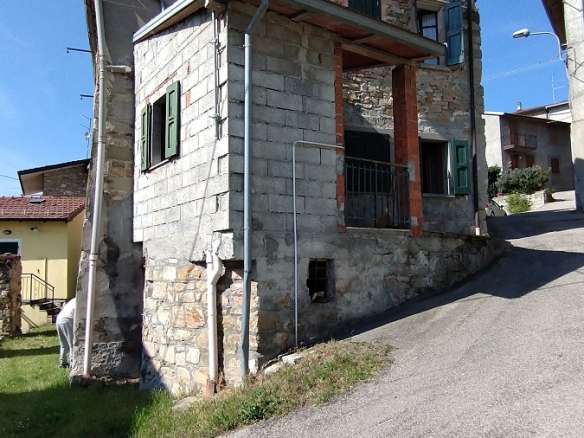
Property here is mainly stone houses in small hamlets, often with a cellar, an attached barn or a piece of land, as well as larger farmhouses in the countryside. Many need modernisation, which is reflected in their prices.
Villa Minozzo and the High Apennines
Villa Minozzo is a large mountain comune reaching up towards Monte Cusna, one of the highest peaks of the northern Apennines, and much of its upper ground lies within the Tuscan-Emilian Apennine National Park. Its villages are surrounded by chestnut and beech forests, mountain streams and summer pastures.
Homes here are traditional mountain houses built in stone, with thick walls and wooden roof structures, and some farm properties with outbuildings and land. Further west, the comune of Ventasso includes the Cerreto pass and the small ski area of Cerreto Laghi, close to the Tuscan border.
Carpineti, Casina and the Hills of Matilda
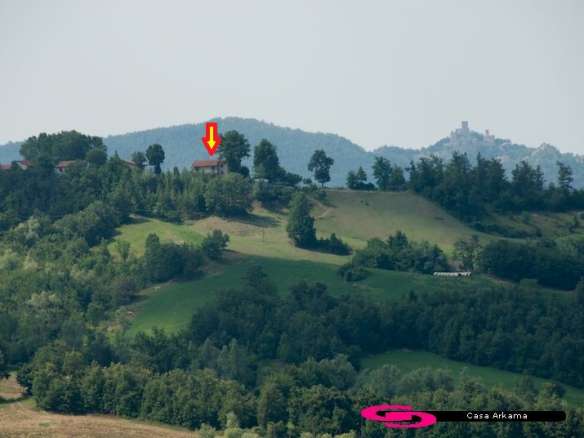
Carpineti lies in the lower hills and is known for the castle of Le Carpinete, one of the strongholds of Matilda of Canossa, the medieval countess who ruled much of northern Italy. The ruins of Canossa castle itself, where Emperor Henry IV came to seek the pope’s forgiveness in 1077, stand a short way north. Casina, Baiso and San Polo d’Enza belong to the same band of hills, with farmhouses and village homes among fields, woods and clay badlands.
The Pietra di Bismantova, a flat-topped sandstone outcrop near Castelnovo ne’ Monti, is the best-known landmark of the area and is mentioned by Dante.
Reggio Emilia and the Plain
The city of Reggio Emilia has a compact historic centre of squares, porticoes and churches, and it is where the Italian tricolour flag was first adopted in 1797. It provides hospitals, schools, shopping and good rail links. The plain north of the city, towards Gattatico and the Po, is intensively farmed and produces milk for Parmigiano Reggiano, with large farmhouses and rural buildings rather than hill villages.
Property and Lifestyle in Reggio Emilia Province
The province suits buyers who want a quiet mountain or hill home at a low price, within reach of some of Italy’s most prosperous cities. Castelnovo ne’ Monti is the main service town of the Apennines, with a hospital, schools and shops, while smaller villages may have only a bar, a grocery and a weekly market. Winters in the mountain villages are cold and snowy, and some services are reduced outside the summer.
Food is central to life here. The province shares the Parmigiano Reggiano production area with Parma, and Lambrusco, erbazzone (a savoury chard pie) and cappelletti in broth are local staples. Hiking, mountain biking, mushroom and chestnut gathering and winter sports in the national park provide plenty of outdoor activity.
Airports and Transport Connections
Bologna airport is the main international airport for the province, and Milan’s airports, Verona and Pisa are also within reach for the Apennine villages near the Tuscan border. Journey times depend a great deal on the exact location, as mountain roads are winding.
The A1 motorway between Milan and Bologna passes Reggio Emilia, and the city’s Mediopadana station, designed by Santiago Calatrava, is a stop for high-speed trains on the Milan to Bologna line. From the city, the SS63 road climbs through the hills and over the Cerreto pass towards Aulla and La Spezia, and local roads follow the Secchia valley towards Toano and Villa Minozzo. A car is essential in the Apennines.
Buying and Renovating Property in Reggio Emilia Province
Many of the low-priced homes are older stone houses that need significant work. Have a local surveyor (geometra) check that the property matches its cadastral and planning records, and obtain estimates for the roof, damp, insulation, wiring, plumbing and heating, which matters a great deal in a mountain climate.
The Apennines are a seismic area, so a structural assessment is advisable, and any recent works should have the correct certification. The clay hills of the Reggio Apennines are also prone to landslides, so check the stability of the site and whether it falls within a mapped landslide zone.
For rural homes, confirm year-round road access and snow clearance, the water supply, septic systems, boundaries and rights of way. Barns and outbuildings cannot automatically be converted to living space, so confirm their permitted use with the local council.
From stone houses in Toano and mountain homes in Villa Minozzo to farmhouses in the castle country around Carpineti, the Province of Reggio Emilia offers some of the most affordable rural property in northern Italy, close to the food and culture of Emilia.